You're Not Buying a Kiosk. You're Buying a Revenue Channel. Here's the Difference.
 Twitter/X
If you already run ATMs, your first instinct about kiosks is probably: "That's just an ATM with a bigger screen and more setup."
It's not. And that assumption is exactly how operators miss a meaningful revenue category.
An ATM does one thing: dispense cash. It does it efficiently. The surcharge income is predictable, the customer use case is universally understood, and the experience takes about thirty seconds. ATMs are reliable, focused machines — which is exactly what makes them valuable.
A kiosk is a different category of investment. Not a competitor to the ATM. A different answer to a different question.
Here's the Move
The short answer on what a kiosk does: whatever you configure it to do.
A kiosk can handle cash dispensing, yes — but also check cashing, bill payment, money transfers, ticketing, product ordering, loyalty program management, and digital advertising between transactions. The specific capabilities depend on your setup and your customer base. The critical difference is this: an ATM has one revenue stream. A kiosk can have several.
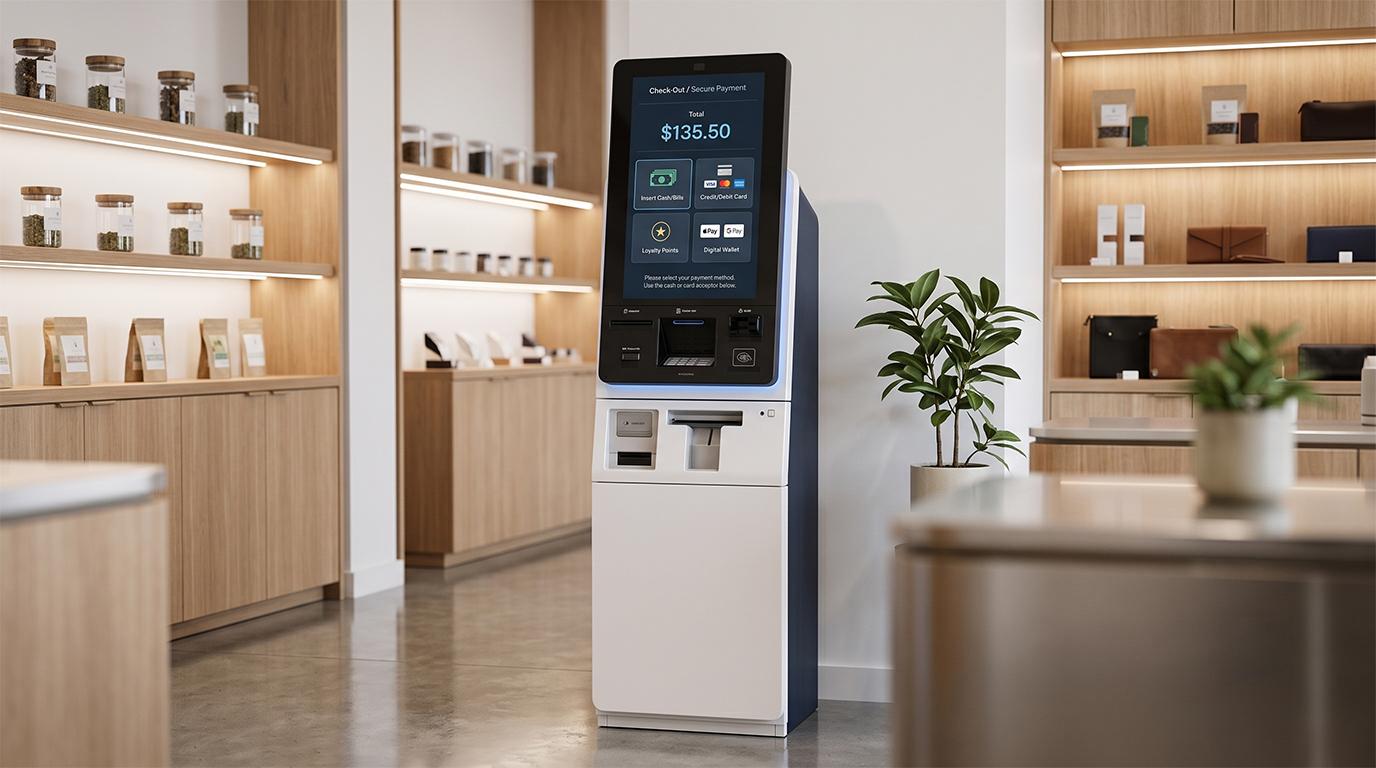
In a dispensary, a kiosk processes the cash-only transaction at the point of sale without requiring a staffed register for every customer. It takes the cash, makes change, completes the transaction, and removes the bottleneck where purchases are most likely to fall apart. Customers get out faster. You process more.
In a transit hub or entertainment venue, a kiosk handles ticketing and transit card top-ups — capturing transactions that would otherwise require staff, an app, or a trip somewhere else entirely.
In a convenience store, a kiosk enables bill payment and money transfers. Financial services that bring a specific customer segment back repeatedly — not because they need gas, but because you've become the place where they handle that errand.
Some Clear Choice kiosks are also configured as cash dispensers — and this is where the operational picture gets interesting for high-cash businesses. Instead of vaulting till cash at close, you route it directly into the kiosk. The kiosk dispenses from that pool, which means less cash sitting in a safe overnight, fewer armored car pickups, and a simpler end-of-day process. For businesses running significant cash volume daily, the savings on vaulting costs alone add up fast.
None of that is an ATM. None of it competes with your ATM. It serves a different customer, doing a different thing.
The operators who add a kiosk alongside an existing ATM almost never see one cut into the other's volume. They see two machines serving different customer needs from the same location. The ATM serves the customer who wants cash. The kiosk serves the customer who needs services — bill pay, check cashing, transfers — that you weren't offering before. You're not splitting the pie. You're making it larger.
A kiosk processing 20 transactions per day at a blended average fee of $3.00 generates $21,900 annually in gross fee revenue. That's before any advertising revenue the screen surface can generate between transactions — digital signage on an active kiosk in a high-traffic location has real value that most operators don't factor in.
For businesses with consistent foot traffic and a customer base running financial errands somewhere else, a kiosk is how you stop sending that revenue out the door.
The real question isn't whether a kiosk makes sense in theory. It's whether your location has the customer volume to support one — and if it does, how quickly you can get something in place. Clear Choice handles setup, integration, and ongoing management. You get the revenue.
Talk to Clear Choice about kiosk options: clearchoicepay.com/book-demo